NVIDIA Vera Rubin AI Chip 2026: Powerful New Processor Explained

NVIDIA’s New Vera Rubin AI Chip 2026: Features, Specifications, Performance, and the Future of Artificial Intelligence
Publisher: News Orbit Wave
The technology industry is entering a new era, and artificial intelligence is becoming one of the most important parts of modern life. From AI chatbots and self-driving cars to medical research, robotics and advanced computing, artificial intelligence is changing how people work and communicate. Behind these developments are powerful computer processors capable of handling enormous amounts of information.
One company leading this technological revolution is NVIDIA. Known worldwide for its graphics processing units (GPUs), gaming technology, and artificial intelligence hardware, NVIDIA continues to develop more powerful computing solutions.
In 2026, NVIDIA introduced its next-generation Vera Rubin AI platform, a major development designed to support advanced artificial intelligence systems. Named after the famous astronomer Vera Rubin, this platform combines several specialized chips to create powerful AI computing infrastructure.
The new platform is designed to improve AI model training, accelerate AI responses, reduce computing costs and support more advanced AI applications.
But what makes NVIDIA’s new processor so special? What are its specifications, features and real-world applications? Let’s explore everything in detail.
What Is NVIDIA’s New Vera Rubin Processor?
NVIDIA Vera Rubin is a next-generation AI computing platform designed for large-scale artificial intelligence workloads.
It is important to understand that Vera Rubin is not simply one computer chip. It is a complete computing platform combining multiple processors, networking components, and specialised technologies.
The platform includes the NVIDIA Vera CPU, NVIDIA Rubin GPU, NVLink 6 Switch, ConnectX-9 SuperNIC, BlueField-4 DPU, and Spectrum-6 Ethernet Switch. NVIDIA also integrated its Groq 3 LPU into the broader platform in 2026.
These components work together to create a powerful AI supercomputer.
The main objective is to make artificial intelligence faster, more efficient, and more affordable to operate at large scale.
For example, modern AI systems must process huge amounts of information when answering questions, generating images, analyzing documents, and completing complex tasks. Traditional computing systems can struggle with these demanding workloads.
Vera Rubin is designed to address these challenges through advanced processing technology and high-speed communication between components.
NVIDIA Rubin GPU: The Heart of AI Computing
The NVIDIA Rubin GPU is one of the most important components of the new platform.
Graphics processing units were originally developed to handle complex graphics calculations in video games and professional visual applications. However, their ability to perform many calculations simultaneously has made them extremely useful for artificial intelligence.
The Rubin GPU is specifically designed for advanced AI training and inference.
Some important specifications and technologies include:
- 336 billion transistors.
- 224 streaming multiprocessors.
- 896 Tensor Cores.
- High-bandwidth HBM4 memory.
- Third-generation Transformer Engine.
- Up to 50 petaflops of NVFP4 inference computing performance.
These specifications make Rubin a powerful solution for demanding AI workloads.
The GPU also uses advanced memory technology to transfer large amounts of information quickly. This is particularly important when running sophisticated AI models containing billions or even trillions of parameters.
Another important feature is its Transformer Engine, which helps accelerate calculations used by modern AI models.
NVIDIA Vera CPU: A Powerful Processor for AI Systems
The NVIDIA Vera CPU is another major part of the new platform.
A CPU, or Central Processing Unit, handles general-purpose computing operations. It manages instructions, processes information and coordinates different parts of a computer system.
While GPUs are particularly effective at parallel calculations, CPUs remain essential for managing tasks, controlling software and coordinating workloads.
The Vera CPU is designed specifically for demanding AI data-centre environments.
Its important features include:
- 88 custom NVIDIA Olympus CPU cores.
- Armv9.2 compatibility.
- High-speed NVLink-C2C connectivity.
- Advanced memory and data-processing capabilities.
- Support for AI reasoning and reinforcement learning.
NVIDIA says the Vera CPU can deliver twice the efficiency and 50% faster performance compared with traditional rack-scale CPUs in its stated workloads.
This combination of CPU and GPU technology helps AI systems perform complicated tasks more efficiently.
NVIDIA Vera Rubin NVL72: An AI Supercomputer
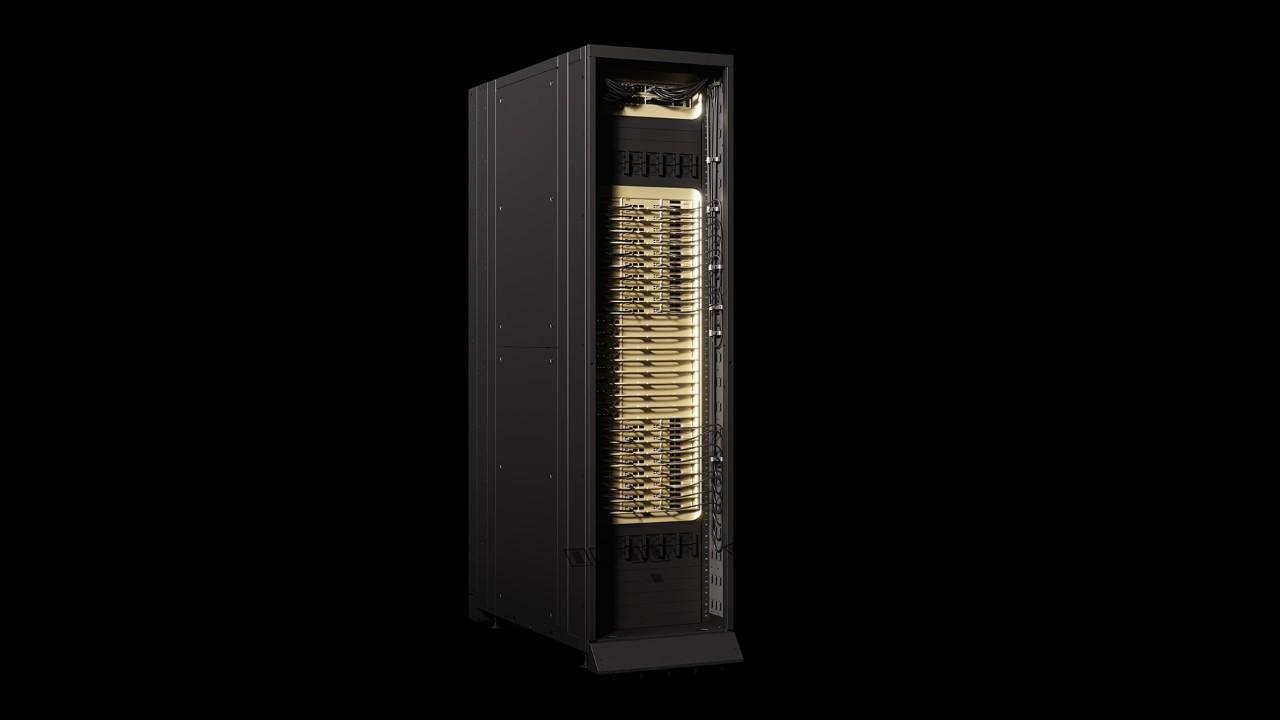
One of the most impressive products based on the Rubin architecture is the NVIDIA Vera Rubin NVL72 rack-scale system.
It is designed to combine multiple processors into one integrated computing system.
The NVL72 configuration includes:
- 72 NVIDIA Rubin GPUs.
- 36 NVIDIA Vera CPUs.
- Sixth-generation NVLink technology.
- High-speed networking components.
- Advanced cooling and power infrastructure.
The system connects its GPUs through high-speed NVLink technology, allowing them to exchange information efficiently.
This is particularly important when training large AI models. Instead of depending on one processor, an AI system can distribute its workload across many GPUs.
Imagine a large team working together on a complicated project. Each member handles a different part of the task, but all members communicate to complete the work. The NVL72 system follows a similar concept.
NVIDIA claims that its Rubin platform can train mixture-of-experts AI models using four times fewer GPUs than its Blackwell platform under its stated comparison.
NVIDIA Rubin vs NVIDIA Blackwell
NVIDIA Blackwell is the previous major generation of NVIDIA AI computing architecture.
It has already become an important platform for AI data centres, cloud computing and advanced machine learning.
However, AI workloads are becoming increasingly complicated. Companies need more computing power while trying to control energy consumption and operating costs.
This is where Rubin aims to make a difference.
| Feature | NVIDIA Blackwell | NVIDIA Rubin |
|---|---|---|
| Architecture | Blackwell | Rubin |
| Generation | Previous generation | Next generation |
| Main focus | AI training and inference | Advanced AI and agentic AI |
| GPU technology | Blackwell GPU | Rubin GPU |
| Memory generation | HBM3e/HBM4, depending on system | HBM4 |
| Transformer Engine | Advanced | Third generation |
| AI efficiency | High | Improved |
One of NVIDIA’s biggest claims is that the Rubin platform can reduce inference token costs by up to 10 times compared with Blackwell.
These are NVIDIA’s platform-level performance claims, not guarantees that every application will experience the same improvement.
Seven Important Components of NVIDIA’s Platform

The Vera Rubin platform combines several specialized components.
1. NVIDIA Vera CPU
The Vera CPU manages general computing operations and supports demanding AI workloads.
2. NVIDIA Rubin GPU
The Rubin GPU performs complex calculations required for AI training, inference, and advanced computing.
3. NVIDIA NVLink 6 Switch
This technology provides high-speed communication between GPUs, allowing multiple processors to work together efficiently.
4. NVIDIA ConnectX-9 SuperNIC
It supports high-speed network communication between computing systems.
5. NVIDIA BlueField-4 DPU
The Data Processing Unit helps manage infrastructure operations, networking, storage, and security tasks.
6. NVIDIA Spectrum-6 Ethernet Switch
It provides high-performance networking for large AI data centers.
7. NVIDIA Groq 3 LPU
The Groq 3 Language Processing Unit is designed to accelerate AI inference, particularly workloads that require fast and predictable responses.
Together, these technologies create a specialized computing environment for advanced AI applications.
How Will NVIDIA’s New Chip Improve Artificial Intelligence?
Artificial intelligence requires enormous computing resources.
When someone asks an AI chatbot a question, the system must process the request, analyze the context, and generate a response.
Large AI models can contain billions of parameters. Training and operating these models requires powerful hardware.
The Rubin platform is designed to improve several areas.
Faster AI training: Developers can train sophisticated AI models using large computing clusters.
Improved AI inference: AI systems can generate responses more efficiently after training.
Advanced reasoning: AI agents can perform multiple steps to solve complicated problems.
Better scalability: Businesses can expand their AI infrastructure to support more users and applications.
Lower operating costs: Greater computing efficiency may reduce the cost of running large AI services.
These improvements could make advanced AI technology more accessible to businesses, researchers, and developers.
Applications of NVIDIA Vera Rubin in Different Industries
NVIDIA’s new AI platform could influence several industries.
Healthcare
AI technology is increasingly being used in medical research, medical imaging, and drug discovery.
Powerful computing systems can help researchers analyze large medical datasets and simulate complex biological processes.
The Vera Rubin platform could support these demanding research applications.
However, AI systems are designed to assist medical professionals rather than independently replace medical judgement.
Automobile Industry
Self-driving technology requires computers to analyze information from cameras, sensors, and other vehicle systems.
AI processors can help autonomous vehicles understand road conditions, recognize objects, and make decisions.
Advanced computing infrastructure can also help companies train and test autonomous driving models.
Robotics
Robotics is another important area for artificial intelligence.
Modern robots need to understand their surroundings, recognise objects and perform complicated tasks.
Powerful AI systems can support the development of intelligent robots used in manufacturing, warehouses, research and other environments.
Education
AI-powered education platforms can provide personalised learning experiences.
Students may use AI assistants to understand difficult subjects, practise languages and receive explanations.
Advanced computing infrastructure helps developers build more capable educational AI systems.
Scientific Research
Scientists use powerful computing systems for climate modelling, physics simulations, weather research and scientific discoveries.
NVIDIA’s Vera Rubin platform is designed to support these demanding workloads.
Entertainment and Gaming
Artificial intelligence is already changing video games, animation, film production and digital content creation.
Powerful GPUs can help developers create realistic visual effects, generate digital environments and accelerate creative workflows.
Energy Efficiency and Advanced Cooling Technology
One of the biggest challenges facing modern AI data centres is electricity consumption.
Large AI systems contain thousands of processors that operate continuously. These systems generate substantial heat and require advanced cooling infrastructure.
NVIDIA’s new platform uses an integrated rack-scale design to improve overall computing efficiency.
Its architecture combines processors, networking, power systems and cooling technologies.
Liquid cooling is particularly important for high-density AI computing systems because traditional air cooling becomes less practical as processor density increases.
Improving performance per watt can help data-centre operators obtain more computing capacity from available electrical power.
However, building and operating large AI facilities still requires significant investment in electricity, cooling systems and infrastructure.
What Is the Difference Between AI Training and AI Inference?
To understand the importance of NVIDIA’s new processor, it is useful to understand two important AI concepts.
AI Training
Training is the process through which an artificial intelligence model learns patterns from large datasets.
For example, an AI image recognition model can be trained using millions of images to identify different objects.
Training requires enormous computing power because the model must repeatedly process information and adjust its internal parameters.
AI Inference
Inference happens when a trained AI model is used to produce an answer or prediction.
For example, when a person asks an AI chatbot a question, the model performs inference to generate a response.
Both operations require powerful hardware.
NVIDIA Vera Rubin is designed to accelerate both training and inference, with particular attention to advanced reasoning and AI agent workloads.
Availability of NVIDIA Vera Rubin in 2026
NVIDIA announced the Rubin platform in January 2026 and subsequently announced its full-production status in March 2026.
By May 2026, the company reported that manufacturing was ramping up through its global supply-chain partners.
NVIDIA has stated that Vera Rubin-based products are being made available through hardware partners and cloud providers during the second half of 2026.
Companies involved in the wider ecosystem include major technology manufacturers and cloud computing providers.
However, availability depends on the particular system, manufacturer, deployment location and cloud service.
It is also important to understand that Vera Rubin is primarily designed for enterprise data centres and AI infrastructure.
It is not a normal desktop processor that consumers can simply install in an everyday laptop.
Advantages of NVIDIA’s New AI Processor
The new platform offers several potential advantages.
High computing performance: Advanced GPUs and CPUs support demanding artificial intelligence workloads.
Improved efficiency: NVIDIA aims to deliver more AI performance using available computing resources.
Advanced memory: HBM4 technology provides high memory bandwidth for demanding AI applications.
Scalability: Multiple processors can operate together as a large computing system.
Advanced networking: NVLink and high-speed networking components support communication between processors.
AI development: Researchers and developers can use the platform to build more sophisticated AI applications.
Enterprise applications: Large organisations can use advanced AI infrastructure for research, automation and data processing.
Challenges and Disadvantages
Despite its impressive technology, NVIDIA’s new processor platform also faces challenges.
High Infrastructure Costs
Building an AI data centre requires expensive processors, servers, networking equipment and cooling infrastructure.
Smaller companies may find it difficult to invest in such systems.
Electricity Requirements
Large AI facilities consume significant amounts of electricity.
Companies must plan their energy requirements carefully.
Cooling Requirements
High-performance processors generate substantial heat. Advanced cooling systems are necessary to maintain reliable operation.
Technology Competition
NVIDIA faces competition from other major technology companies developing their own AI processors and accelerators.
Competition could influence pricing, product availability and future innovation.
Supply Chain Challenges
Manufacturing advanced processors requires specialised production facilities and complex global supply chains.
Production delays or shortages can affect availability.
What Does NVIDIA’s New Chip Mean for the Future?

The development of Vera Rubin represents a major step towards more powerful AI infrastructure.
In the future, AI systems may become capable of performing complicated tasks with less human intervention.
AI agents could help businesses manage operations, analyse documents, write software and coordinate workflows.
Robots may become more capable of understanding physical environments and performing practical tasks.
Scientific researchers could use advanced computing platforms to accelerate discoveries in medicine, energy and climate science.
However, these developments will also raise important questions about data privacy, security, employment and responsible AI development.
The success of next-generation AI technology will depend not only on powerful processors but also on software, regulation, accessibility and responsible implementation.
Official source: NVIDIA Official Website.
Final Verdict: Is NVIDIA Vera Rubin a Major Innovation?
NVIDIA Vera Rubin is one of the most important developments in the company’s AI computing roadmap for 2026.
Its combination of advanced GPUs, CPUs, high-speed networking and specialised AI processors creates a powerful platform for large-scale artificial intelligence.
The Rubin GPU, Vera CPU and NVLink 6 technology are designed to improve performance, communication and efficiency across AI computing systems.
Although the platform is primarily aimed at data centres, cloud providers and enterprise customers, its impact could reach ordinary users through better AI applications, faster services and more advanced digital products.
NVIDIA is not simply developing another processor. It is building the computing infrastructure needed for the next generation of artificial intelligence.
The coming years will show how successfully this technology transforms industries and makes advanced AI more accessible around the world.
News Orbit Wave will continue covering the latest developments in artificial intelligence, technology, computers and global innovation.
Publisher: News Orbit Wave