The Physical AI Era: How Intelligent Machines are Redefining Life and Labor in 2026
Artificial intelligence has officially broken free from the confines of text boxes and digital assistants. In 2026, AI has seamlessly integrated into factories, hospitals, financial institutions, classrooms, and smart homes, marking what sociologists and economists call the most profound technological paradigm shift since the dawn of the internet. We are no longer just living in an information age; we have entered the era of the “AI Revolution.”
The defining characteristic of this shift is the rise of physical AI—intelligent systems capable of perceiving, reasoning, and executing complex physical actions in the real world. Backed by hundreds of billions of dollars from tech titans and robotics pioneers, the boundary between software and hardware has completely dissolved.
From Automation to Augmentation: The New Workforce
The prevailing corporate narrative has fundamentally shifted from replacing human labor to augmenting it. Rather than displacing workers, next-generation AI is being deployed to act as a force multiplier for human capability.
-
Financial Agility: Global banking institutions, including Goldman Sachs, are actively deploying sophisticated “digital agents” designed to handle data-heavy financial modeling, allowing analysts to focus on high-level strategy and client relations.
-
Precision Healthcare: In operating rooms, AI-driven surgical assistants analyze real-time anatomical data, offering predictive insights to surgeons during complex procedures to minimize risk and improve patient outcomes.
-
Smart Supply Chains: In logistics, autonomous systems manage fluctuating inventory demands dynamically, creating safer, more efficient warehouse environments.
Industry Insight: The current goal of corporate AI deployment is workforce stability paired with exponential productivity gains—positioning AI as a collaborative partner rather than a replacement.
Robots Move Beyond the Factory Floor
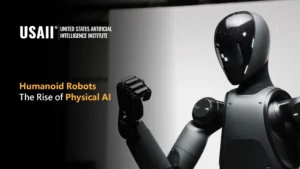
The most visible manifestation of Physical AI is the rapid evolution of humanoid robotics. Driven by breakthrough generalized foundation models, modern robots have evolved past rigid, pre-programmed instructions. They now learn much like humans do: through observation, trial-and-error, and contextual awareness.
The Tech Powering the Shift
Recently, NVIDIA and leading robotics firms unveiled next-generation AI spatial models. These brains allow robots to:
-
Map and Understand: Process complex 3D environments in real time.
-
Generalize Tasks: Apply skills learned in one environment (like sorting packages in a lab) to an entirely new one (like managing a dynamic retail backroom) without requiring new code.
-
Execute Domestic Chores: Perform nuanced household tasks—such as preparing coffee, folding laundry, and organizing spaces—with human-like dexterity.
The Ethical Crossroads: Regulation, Morality, and Anxiety
As AI’s footprint expands, so does the intensity of the global debate surrounding its guardrails. The rapid integration of autonomous systems has forced traditional institutions to confront unprecedented ethical questions.
Global Governance and Moral Oversight
The conversation has moved far beyond tech circles. In a historic move, the Vatican established a dedicated AI study group tasked with analyzing the profound moral, ethical, and social consequences of non-human intelligence. Governments worldwide are similarly racing to draft agile regulatory frameworks that protect data privacy and combat AI-generated misinformation without stifling innovation.
The Public Divide
Public sentiment remains deeply fractured. While technologists celebrate massive leaps in efficiency, public discourse on social platforms reflects acute anxiety regarding:
Job Displacement: The fear that white-collar and blue-collar roles alike will face structural unemployment.
Economic Disparity: The risk of wealth concentration, where the financial benefits of the AI boom overwhelmingly favor mega-corporations over the average workforce.
The Horizon: Co-Intelligence as the New Normal
Despite structural growing pains, the consensus among academic researchers and forward-looking tech leaders points toward a future of co-intelligence.
AI is maturing into an essential cognitive tool that elevates human creativity, sharpens strategic decision-making, and handles mundane cognitive loads. The next phase of this evolution will see even deeper integration: hyper-personalized digital twins, autonomous industrial ecosystems, and intelligent robotic companions woven into the fabric of daily life.
Whether viewed through a lens of techno-optimism or cautious skepticism, one reality is undeniable: the AI revolution is no longer a future forecast. It is actively reshaping human society in real time.