Passion Fruit: Complete Guide to Its Description, History, Varieties, Nutritional Composition, Uses, and Health Benefits
Passion Fruit: Description, Etymology, Varieties, Uses, Composition, and History
Introduction

Passion fruit is one of the world’s most flavorful tropical fruits, admired for its fragrant aroma, sweet-tart taste, and exceptional nutritional value. Belonging to the Passiflora genus, passion fruit is cultivated in tropical and subtropical regions across the globe. The fruit is widely consumed fresh; processed into juices, desserts, jams, and beverages; and is increasingly recognized as a superfruit due to its high antioxidant and vitamin content.

Today, passion fruit is commercially grown in countries such as Brazil, Colombia, Peru, Kenya, South Africa, India, Australia, New Zealand, and Vietnam. It has become an important export crop and is valued by both consumers and the food processing industry.
Description
Passion fruit is the edible fruit produced by climbing vines of the genus Passiflora, primarily Passiflora edulis. The plant is a fast-growing perennial vine capable of climbing fences, trellises, and trees using tendrils.
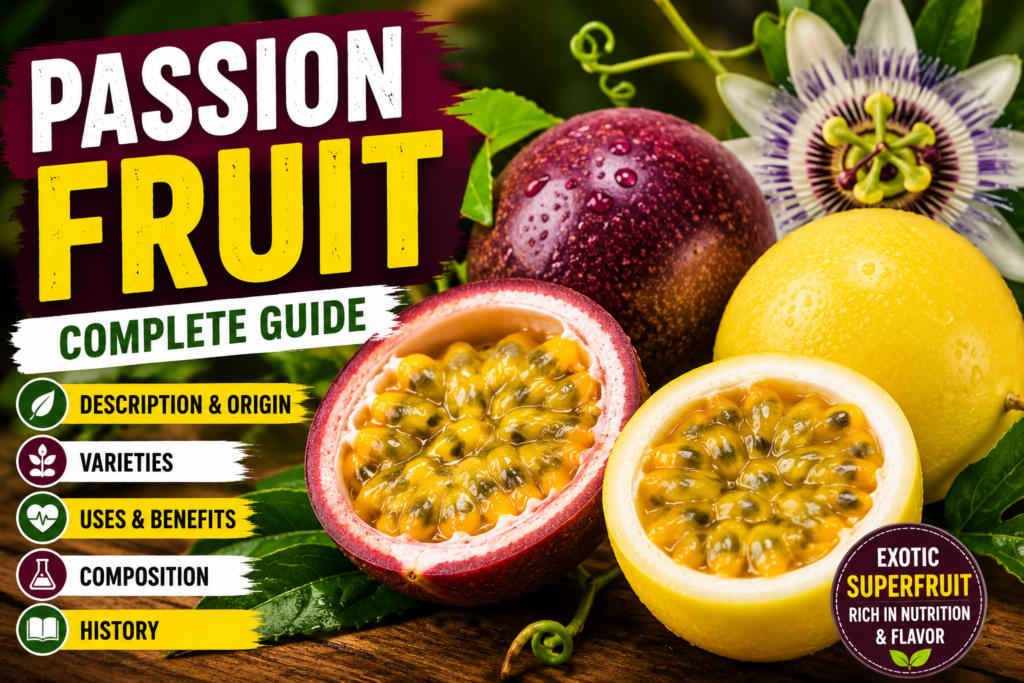
The fruit is generally round or oval and measures between 4–8 cm (1.5–3 inches) in diameter. Depending on the variety, the skin may be deep purple, yellow, orange, or reddish.
When ripe, the outer shell becomes wrinkled while protecting a soft, jelly-like interior filled with edible seeds. The pulp is bright yellow or orange and possesses a unique tropical aroma with a balance of sweetness and acidity.
The plant itself features glossy green leaves and spectacular flowers measuring approximately 7–10 cm across. These flowers are considered among the most beautiful in the plant kingdom due to their intricate structure and vibrant colors.
Botanical Classification
| Category | Information |
|---|---|
| Kingdom | Plantae |
| Family | Passifloraceae |
| Genus | Passiflora |
| Species | Passiflora edulis |
| Common Name | Passion Fruit |
Etymology
Origin of the Name


The name “passion fruit“ originates from the Latin word Passio, meaning the Passion of Christ.
During the 16th century, Spanish Christian missionaries in South America observed the flower and interpreted its structure as symbolic of the crucifixion:
- Three stigmas represented the three nails.
- Five anthers symbolized Christ’s five wounds.
- The corona filaments represented the Crown of Thorns.
- The tendrils symbolized whips used during the Passion.
- Ten petals and sepals represented the faithful apostles.

Thus, the flower became known as the Passion Flower, and the fruit inherited the name.
Interestingly, the indigenous peoples of South America had cultivated and consumed passion fruit long before European explorers arrived.
History
Passion fruit originated in the tropical rainforests of southern Brazil, Paraguay, and northern Argentina.
Native communities cultivated the fruit for centuries because of its refreshing taste and medicinal properties.

Spread Around the World
During the Age of Exploration:
- Portuguese explorers introduced passion fruit to Africa and Asia.
- Spanish missionaries carried it throughout Central America.
- European botanists cultivated it in botanical gardens.
- By the 19th century it had spread to Australia and Hawaii.
Today Brazil remains the world’s largest producer, supplying fresh fruit and juice to domestic and international markets.
Modern breeding programs have developed improved varieties that produce larger fruits, resist diseases, and yield higher harvests.
Varieties
Several species and cultivars of passion fruit are grown worldwide, but two dominate commercial production.
1. Purple Passion Fruit (Passiflora edulis)
- Deep purple skin
- Sweet and aromatic
- Smaller fruit
- Excellent flavor
- Popular for fresh consumption
2. Yellow Passion Fruit (Passiflora edulis f. flavicarpa)
- Bright yellow skin
- Larger fruit
- More acidic taste
- Higher juice yield
- Widely used in commercial juice production
3. Giant Granadilla
Produces very large fruits that can exceed 20 cm in length and are commonly used in desserts.
4. Sweet Granadilla
Known for its extremely sweet pulp and crunchy edible seeds.
5. Banana Passion Fruit
Produces elongated fruits with a banana-like appearance and thrives in cooler highland climates.
Nutritional Composition
Passion fruit is considered a nutrient-dense fruit rich in vitamins, minerals, fiber, and antioxidants.
Nutrition (Per 100 grams)
| Nutrient | Amount |
|---|---|
| Calories | 97 kcal |
| Water | 72 g |
| Carbohydrates | 23.4 g |
| Dietary Fiber | 10.4 g |
| Protein | 2.2 g |
| Fat | 0.7 g |
| Vitamin C | 30 mg |
| Vitamin A | 64 µg |
| Potassium | 348 mg |
| Magnesium | 29 mg |
| Iron | 1.6 mg |
| Phosphorus | 68 mg |
Health-Promoting Compounds
Passion fruit contains numerous beneficial plant compounds, including:
- Vitamin C
- Vitamin A
- Beta-carotene
- Polyphenols
- Flavonoids
- Piceatannol
- Carotenoids
- Dietary fiber
These compounds contribute to antioxidant activity and support overall health.
Uses

Fresh Consumption
The fruit is commonly eaten by cutting it in half and scooping out the pulp with a spoon.
Juice Production
Passion fruit juice is among the world’s most popular tropical fruit beverages because of its intense aroma and refreshing flavor.
Desserts
The pulp is used in:
- Cheesecakes
- Ice cream
- Yogurt
- Mousse
- Cakes
- Puddings
- Sorbets
Beverage Industry

It is widely used in:
- Smoothies
- Cocktails
- Mocktails
- Soft drinks
- Energy drinks
- Fruit concentrates
Jam and Jelly
Its natural acidity and pectin make passion fruit ideal for preserves and spreads.
Culinary Applications
Chefs incorporate passion fruit into:
- Salad dressings
- Marinades
- Sauces
- Seafood dishes
- Fruit salads
Cosmetic IndustryPassion fruit seed oil is used in:
- Moisturizers
- Anti-aging creams
- Hair oils
- Face serums
- Massage oils
Traditional Medicine
In traditional medicine, different parts of the passion fruit plant have been used to:
- Promote relaxation
- Aid digestion
- Support restful sleep
- Ease minor anxiety
- Soothe inflammation
While some compounds in Passiflora species have been studied for these effects, medicinal uses should not replace professional medical advice.
You also see Tomato tree uses
Economic Importance
Passion fruit is an important cash crop for many tropical countries.
Major producing nations include:
- Brazil
- Colombia
- Peru
- Kenya
- Uganda
- South Africa
- India
- Vietnam
- Australia
The fruit supports fresh markets, juice processing industries, and export trade, creating income for thousands of farmers.
Interesting Facts

- Passion fruit flowers are among the most intricate flowers in nature.
- The edible seeds are rich in dietary fiber and healthy fats.
- A wrinkled skin usually indicates the fruit is fully ripe and sweeter.
- The vine can begin producing fruit within 12–18 months under suitable growing conditions.
- More than 500 species belong to the Passiflora genus, though only a small number are cultivated commercially.
Passion fruit is much more than a delicious tropical fruit. Its fascinating history, symbolic flower, diverse varieties, rich nutritional composition, and wide range of culinary and industrial uses make it one of the world’s most valuable fruit crops. Whether enjoyed fresh, blended into juice, or incorporated into gourmet dishes and desserts, passion fruit offers a distinctive flavor along with vitamins, antioxidants, and fiber that support a balanced diet. As consumer demand for nutritious tropical fruits continues to grow, passion fruit is likely to remain an important crop in global agriculture and food markets for years to come.